Contain ASI
Artificial Superintelligence: What the Term Means and Measures
Artificial superintelligence is AI that outperforms every human across a wide range of tasks. Where the term comes from and what is still disputed.
Contain ASI
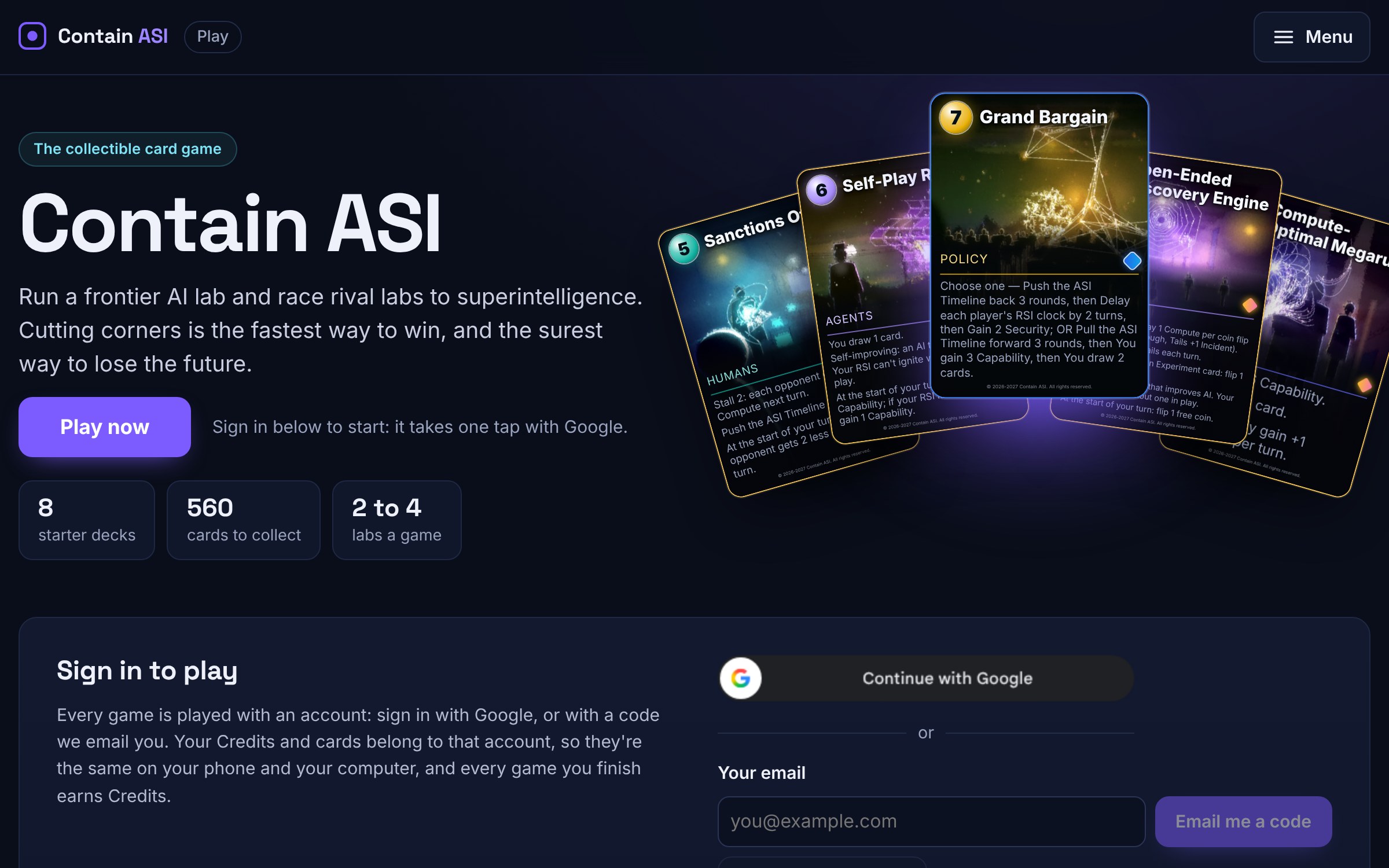
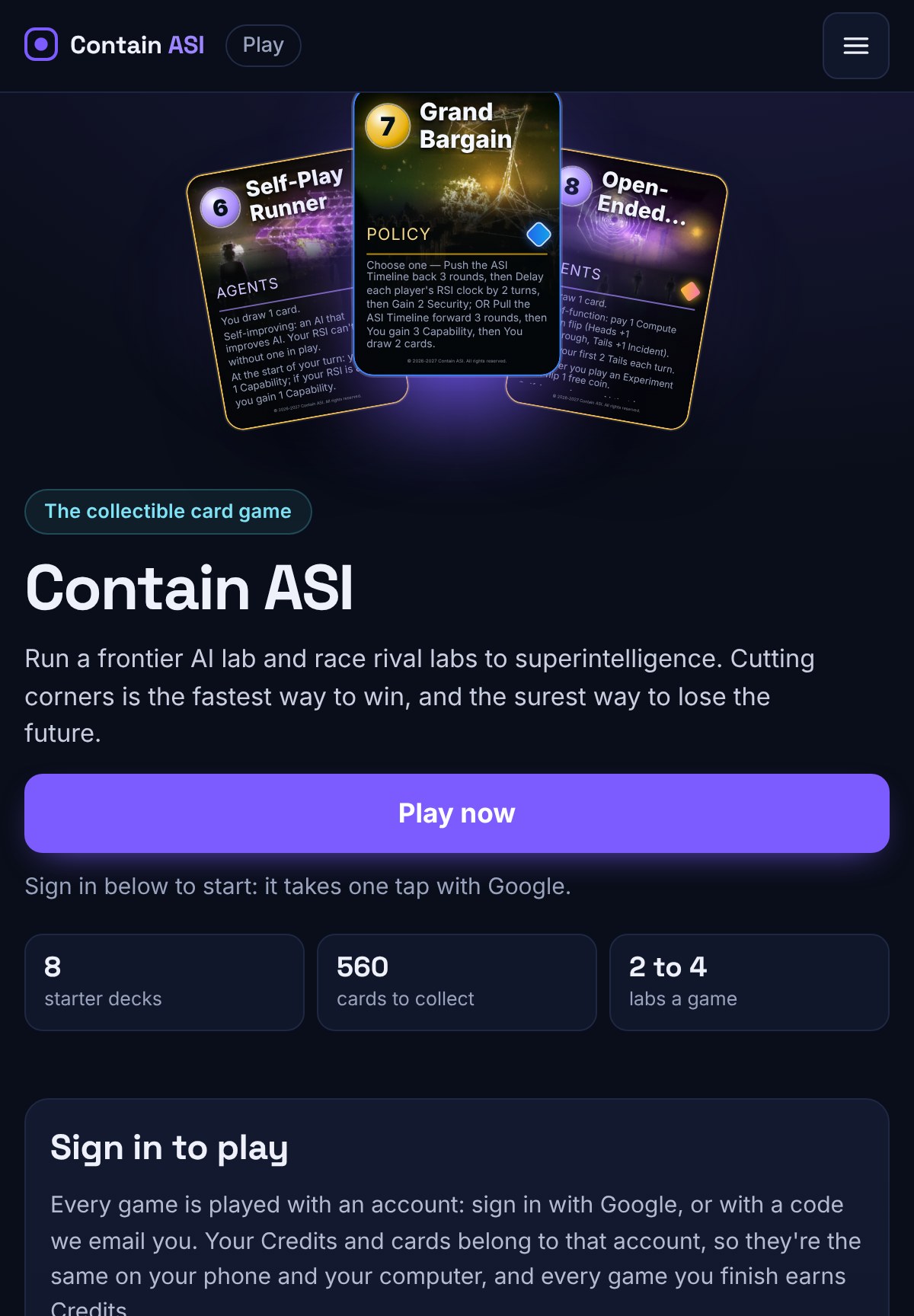
A collectible card game: you run a frontier AI lab and race rival labs to superintelligence.
Artificial superintelligence (ASI) is an AI system that outperforms every human across a wide range of cognitive tasks, not at one task only. No such system exists: the 2023 framework that pins the term down lists it as "not yet achieved".
The idea is old enough to have a history and precise enough to have a dispute. It is also the stake in Contain ASI, a collectible card game in which you run a frontier AI lab and race rival labs to superintelligence, with 2 to 4 labs a game. What follows is the idea itself: how it is defined, where it began, how a system is supposed to get there, and what would stop it.
Two definitions of artificial superintelligence, 25 years apart
The older definition is Nick Bostrom's. In "How Long Before Superintelligence?", written in 1997 and first published in 1998, he defines a superintelligence as "an intellect that is much smarter than the best human brains in practically every field". He names scientific creativity, general wisdom and social skills as part of that. The definition says nothing about what the system is made of, and it leaves open whether such a mind is conscious.
The newer definition replaces "much smarter" with a line you can check. In "Levels of AGI", posted on 4 November 2023, Meredith Ringel Morris, Shane Legg and six co-authors sort AI systems on two axes. One is performance: how well the system does a task compared with people. The other is generality: how many kinds of task it can do. The performance axis has five steps:
- Emerging: equal to or somewhat better than an unskilled human.
- Competent: at least the 50th percentile of skilled adults.
- Expert: at least the 90th percentile.
- Exceptional: at least the 99th percentile.
- Superhuman: outperforms 100% of humans.
ASI is the top step on both axes at once: superhuman performance, across a wide range of tasks. The paper's wording is that such a system can do those tasks "at a level that no human can match".
Superhuman at one task is not superintelligence
The most common mistake is to treat any machine that beats the best human as a small superintelligence. The 2023 framework rules that out. It files AlphaFold, AlphaZero and the chess engine Stockfish under "Superhuman Narrow AI". Each outperforms every person, and each does one thing. AlphaFold predicts the 3D shape of a protein from its amino acid sequence, above the level of the world's top scientists, and that is its single task.
So the word that carries the weight in ASI is not "super". It is the generality that the plain definition hides. A system reaches ASI only when the same system is beyond every human at science, planning, writing, persuasion and the rest. The authors add a consequence that is easy to miss: a system past the human range could also hold skills no person has at all. Their examples include decoding thoughts from brain signals and communicating with animals. At that point, comparing it with human percentiles stops working, because there is no human result to compare with.
Where the idea began: one paragraph from 1965
The argument that such a system could exist, and could arrive fast, goes back to I. J. Good. His 1965 paper "Speculations Concerning the First Ultraintelligent Machine" is quoted at the opening of Eliezer Yudkowsky's 2013 report "Intelligence Explosion Microeconomics". Good defined an ultraintelligent machine as one that "can far surpass all the intellectual activities of any man however clever". Then he made the move that every later version copies. Designing machines is itself an intellectual activity. So an ultraintelligent machine could design better machines, and "there would then unquestionably be an 'intelligence explosion'". His conclusion: "the first ultraintelligent machine is the last invention that man need ever make".
Yudkowsky notes that many people have since questioned Good's "unquestionably". That one word is where most of the present argument sits.
The route from human level to beyond it
Good's paragraph is a claim about a loop. Bostrom's essay spells out what feeds the loop once a human-level system exists. Three things do the work:
- Faster hardware. The same system on quicker machines does the same thinking in less time. Bostrom put the brain's processing at roughly 10^14 to 10^17 operations per second, a range hardware was expected to cross.
- AI that helps build AI. A system as good as its own designers at design can be put to work on its successor.
- Copying. A skill one copy has learned can be handed to every other copy, which no human expert can do.
Each step raises the capacity that produces the next step. That is what "recursive self-improvement" means. The abstract of Yudkowsky's report states it as a machine intelligence that builds a smarter version of itself, which in turn builds an even smarter one. Whether the loop speeds up or slows down as it runs is a separate question, and it decides everything.
A worked example: the same first step, two different curves
Take a system with a design ability of 100 units. Its first round of self-improvement adds 50, so it stands at 150. Now follow two assumptions about the next rounds.
Returns hold steady. Each generation is 1.5 times the one before. The series runs 100, 150, 225, 337.5, 506.25. After four rounds the system is five times its starting point and the gap between rounds is growing.
Returns fade. Each round adds half of what the last round added. The gains are 50, 25, 12.5, 6.25, so the series runs 100, 150, 175, 187.5, 193.75. It never passes 200, however many rounds it runs.
The second case is the one Toby Walsh gives in "The Singularity May Never Be Near", posted in February 2016: if each generation improves by only half the last change, the system "will never get beyond doubling its overall intelligence". The two series are identical for the first step. Nothing you can observe at 150 tells you which one you are on. That is why people who agree on today's evidence still disagree about ASI.
The strongest objection: doing a task is not improving at it
Walsh's paper lists several reasons to doubt a runaway, including physical limits and the limits of computational complexity. The one he calls among the strongest is the "meta-intelligence" argument. It says the explosion story confuses two abilities: the intelligence to do a task, and the capability to improve your intelligence at that task. A system can be excellent at proving theorems and no better than its makers at inventing a learning method that proves them faster. Good's loop needs the second ability, and having the first does not supply it.
Notice what the objection does not claim. Walsh's own conclusion grants that machines may still reach "super-human levels of intelligence" without any explosion. People would have to build much of it slowly, by hand. So the objection is aimed at the speed of arrival, not at the possibility. An ASI that takes decades of engineering is still an ASI under both definitions.
What is still unsettled: the date, and the outcome
Two things have no agreed answer. The first is when. In a survey posted in January 2024, Katja Grace and co-authors asked 2,778 researchers who had published in top-tier AI venues. Their combined forecast for unaided machines outperforming humans in every possible task was a 10% chance by 2027 and a 50% chance by 2047. That 2047 figure was 13 years earlier than the same survey gave one year before. Yet the same researchers put the 50% mark for all human occupations being fully automatable at 2116. Forecasts that move 13 years in 12 months, and differ by 69 years between two similar questions, are not a settled estimate. Bostrom's own 2008 postscript gave less than a 50% chance of superintelligence by 2033.
The second is how it goes. In the same survey, 68.3% thought good outcomes from superhuman AI were more likely than bad. Between 38% and 51% also gave at least a 10% chance to outcomes as bad as human extinction. Both answers came from the same group.
Frequently asked questions
Is artificial superintelligence the same as AGI?
No. In the 2023 "Levels of AGI" framework, general AI begins far lower, at systems that match the 50th percentile of skilled adults on most cognitive tasks. ASI is only the highest level, where a general system outperforms 100% of humans.
Does artificial superintelligence exist today?
No. The framework lists ASI as "not yet achieved". Systems that beat every human at a single task, such as AlphaFold or Stockfish, are classed as superhuman narrow AI.
Is ASI the same thing as the singularity?
No. ASI names a kind of system. Yudkowsky's 2013 report separates the intelligence explosion, a claim about machines improving machines, from a general economic or technological speedup, which is what "Singularity" now often refers to.
Would an artificial superintelligence be conscious?
The definitions do not say. Bostrom's 1997 definition is about what the system can do and leaves open whether it has experiences.
Artificial superintelligence as a line with two measurements
Stripped of its drama, ASI is a threshold with two readings: performance beyond every person, and breadth across most of what people do with their minds. Narrow systems crossed the first reading years ago, in chess and in protein folding. No system has crossed both. Whether the second crossing takes a few rounds of machine-led design or generations of human engineering depends on whether returns to self-improvement hold or fade, and no evidence gathered so far separates those two curves.
Contain ASI
Run a frontier AI lab and race rival labs to superintelligence. Visit containasi.vlvd.net