WordTwist
Breaking a Word Into Syllables: Why It Helps You Say It
Breaking a word into syllables helps you say it because speech is assembled from stored syllable movements. The mechanism, its limits and one example.
WordTwist
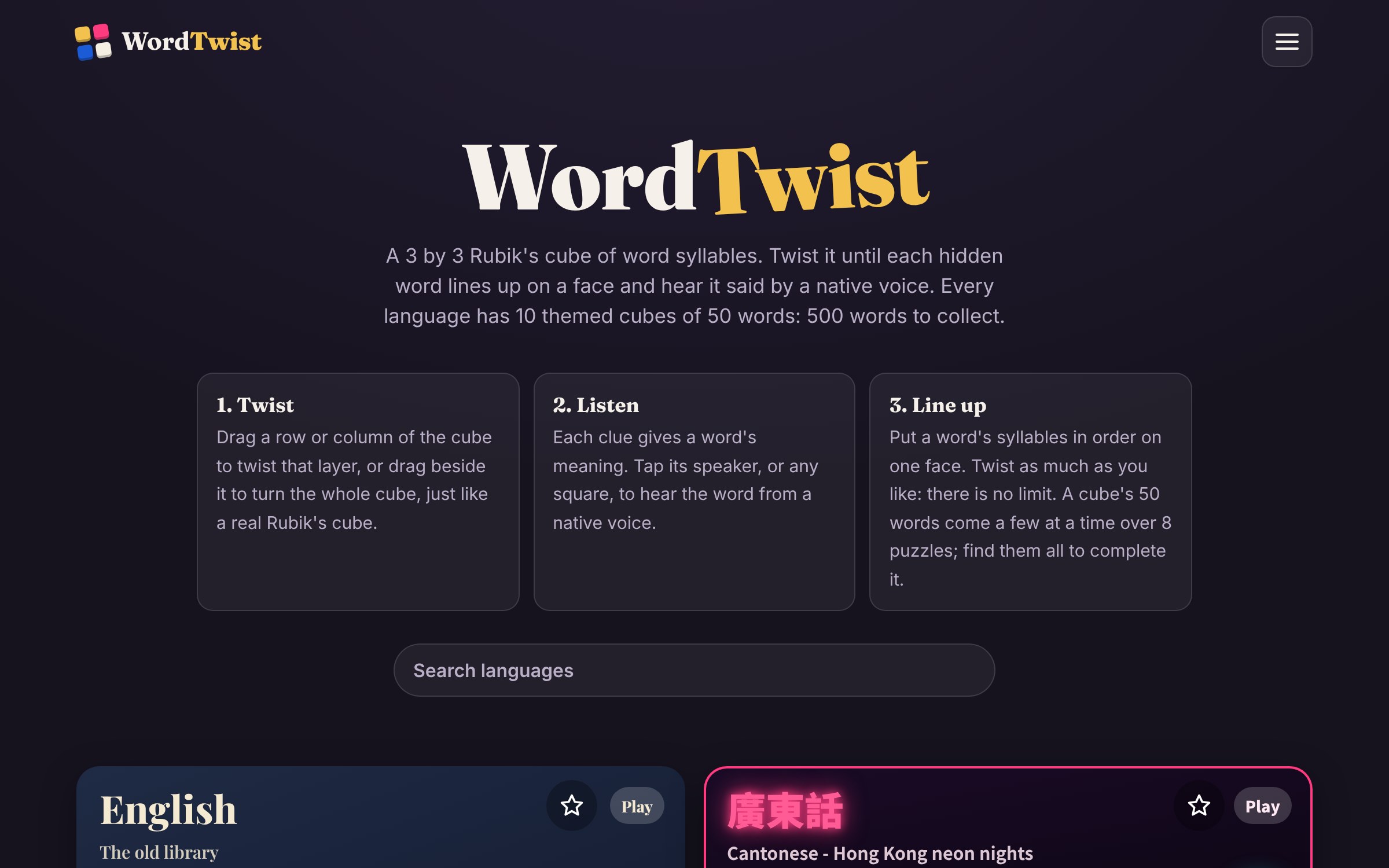
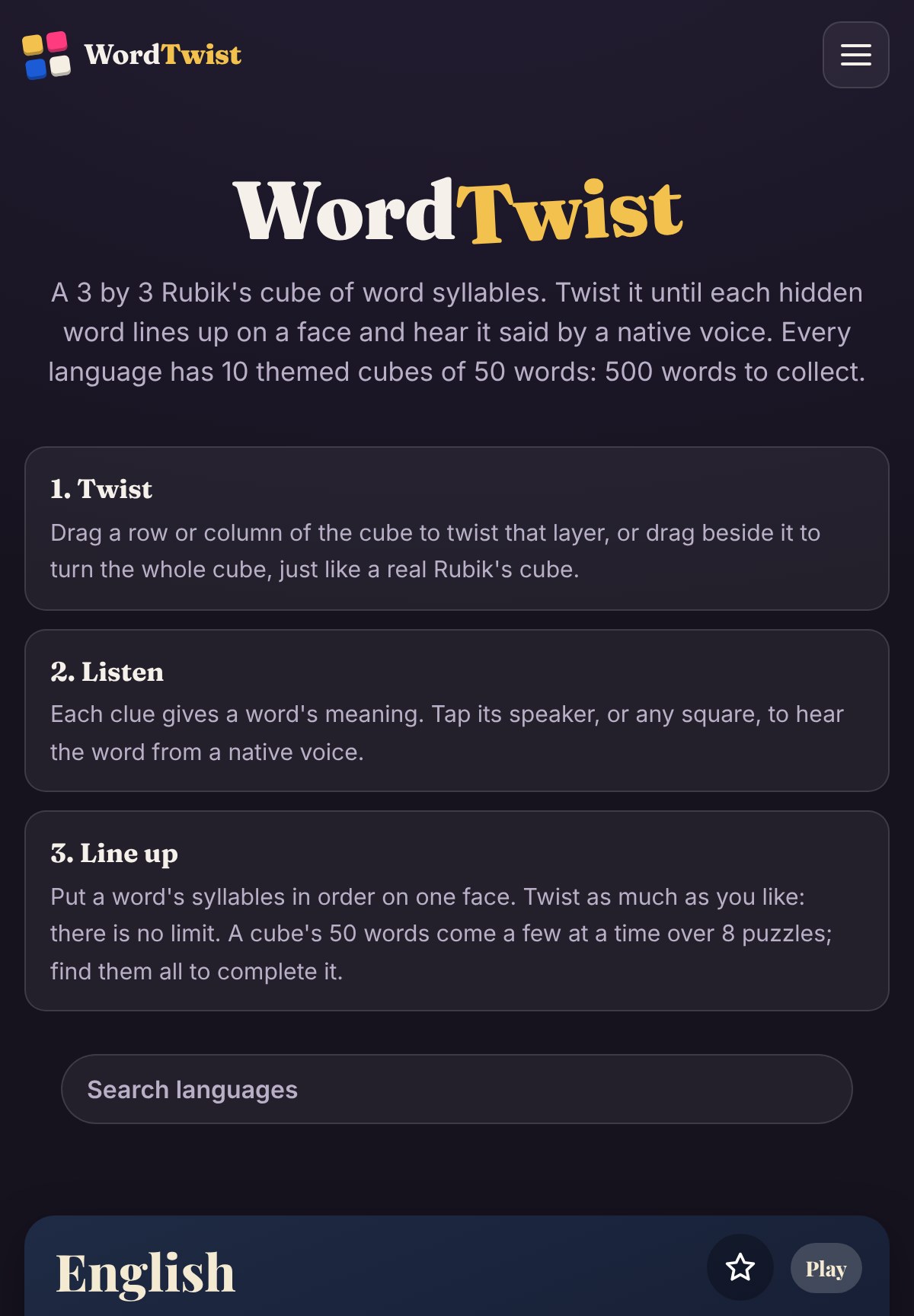
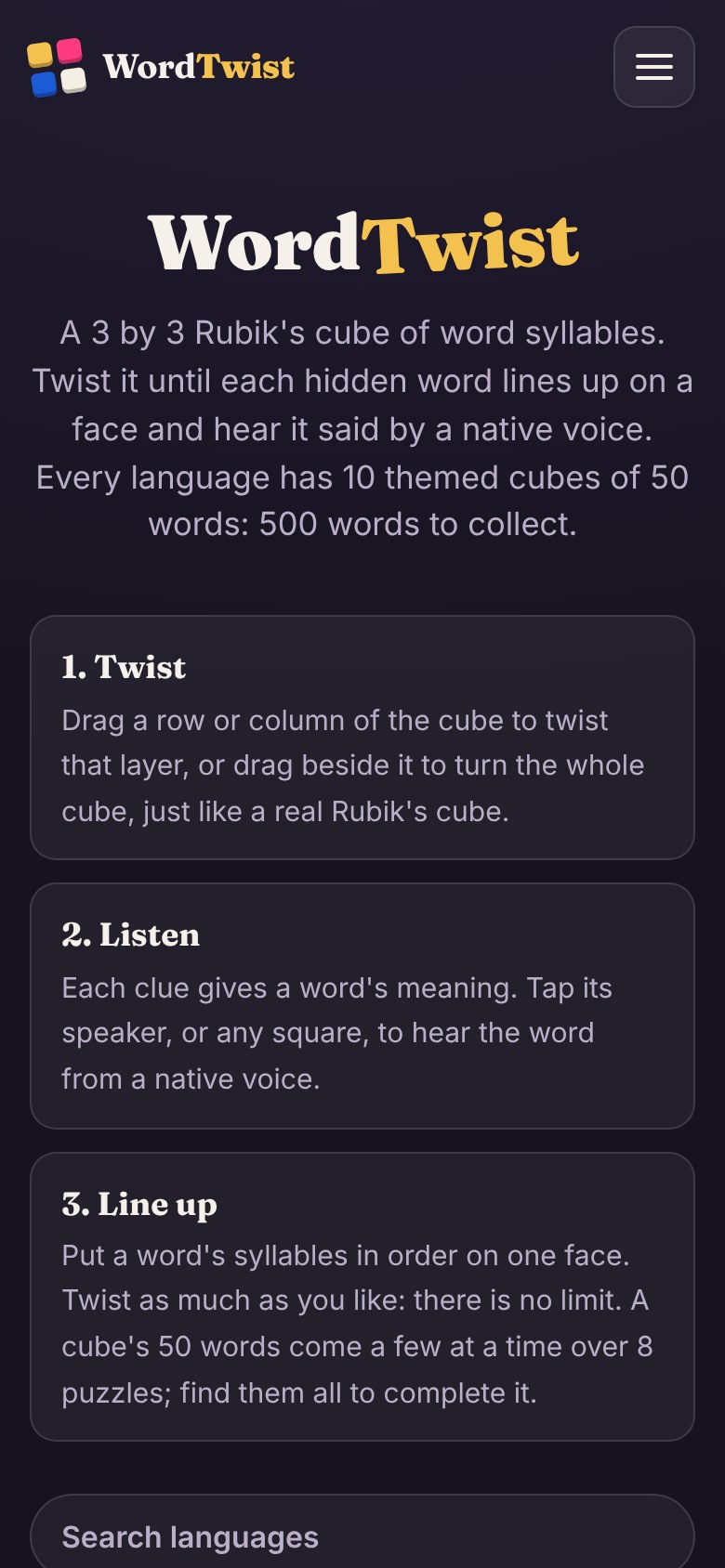
A word puzzle on a 3 by 3 cube of syllables: twist rows and columns until each hidden word lines up on a face, hear it said by a native voice, and collect a language's words cube by cube.
Breaking a word into syllables helps you say it because the syllable is the piece of speech your mouth already has a stored movement for. A long new word then stops being one unfamiliar movement and becomes a short sequence of movements you can mostly make already, with one or two new ones to practise.
That is a claim about how speech is produced, and it has been measured since the 1990s. It also has a limit that most pronunciation advice leaves out: the unit that speakers reach for first is not the same in every language. WordTwist, a word puzzle on a 3 by 3 cube of syllables in which each hidden word is lined up on a face and said by a native voice, uses the syllable as its playing piece, so the same question decides what a player there is practising.
What breaking a word into syllables changes in your mouth
Saying a word has two late stages. First the speaker works out the word's sound form. Then that form is turned into commands for the tongue, lips, jaw and voice. The leading account of the second stage is the mental syllabary, proposed by Willem Levelt and Linda Wheeldon in the journal Cognition in 1994. On this account the speaker produces syllables one after another, and for each one fetches a ready-made set of articulatory gestures from a store.
The evidence was a timing effect. Words that ended in a common syllable were named faster than words that ended in a rare one. The effect was separate from how common the whole word was, and it was not caused by the final syllable being harder to pronounce. A syllable used often seems to be fetched faster, which is what a store of syllables predicts and what building each word from scratch does not.
For a learner, the consequence is direct. A syllable that also exists in your own language is already in the store. A syllable that does not exist there has to be built slowly, sound by sound. Splitting the word shows you which is which.
Where the syllabary idea comes from, and how it was checked
Levelt and Wheeldon worked at the Max Planck Institute for Psycholinguistics in Nijmegen, and the syllabary became part of a full theory of word production that Levelt, Ardi Roelofs and Antje Meyer published in 1999. In March 2006 Joana Cholin, Levelt and Niels Schiller put the idea to a stricter check. They used invented words, so that nothing about a real word's meaning or familiarity could explain the result.
Their paper states the idea in one line: the syllabary supplies "pre-compiled" motor programs, so the speaker does not construct the program for each syllable while speaking. Speakers began one-syllable invented words faster when the syllable was a common one. With two-syllable invented words the effect showed when the first syllable was the common one, and not when the second was. The store is consulted at the moment speech starts, one syllable ahead.
Why a new word slips away before you can say it
There is an earlier bottleneck than the mouth. Before you can say a new word you have to hold its sound for a second or two. In January 1998 Alan Baddeley, Susan Gathercole and Costanza Papagno gathered the studies of word learning in adults, children and patients, and argued that the phonological loop, the part of working memory that holds speech sounds, exists mainly for this job. In their words, its primary purpose is "to store unfamiliar sound patterns while more permanent memory records are being constructed". Remembering lists of familiar words, the task it is usually measured with, is secondary.
An unfamiliar sound pattern is exactly what a foreign word is. The loop is small, and a pattern that does not match anything you know fades fast. A single syllable is a short pattern. Three syllables heard as one blur are a long one. Working one syllable at a time keeps each pattern short enough to hold while the longer record forms. This last step is an inference from the 1998 paper, not a result it reports.
A worked example with one three-syllable word
The Dutch card on the puzzle's home page shows three squares: dank, je and wel. Together they make dankjewel, a Dutch way to say thank you. The word has 9 letters and 3 syllables.
- Hear the whole word once from a native speaker. You now have a target, but it is one long sound pattern.
- Take the syllables singly and say each one after the voice. Suppose dank and wel come out right the first time and je does not. That is one new program to build, not three.
- Put them in order. Three pieces can be arranged in 6 ways, and only one of the 6 is the word. In the puzzle the word counts only when its syllables sit in order on one face.
- Say all three at speaking speed, with no gap, and compare with the native voice again.
The consequence is in step 2. Read letter by letter, the word is 9 decisions. Split into syllables, it is 3, and 2 of them cost you nothing. Your practice time goes to the one syllable that needs it.
The strongest objection: English speakers do not start from syllables
In May 2010 Padraig O'Seaghdha, Jenn-Yeu Chen and Train-Min Chen published 7 experiments on which unit speakers prepare first. Mandarin speakers got faster when they knew the first syllable of a word in advance, and gained nothing from knowing only its first sound. English speakers were the opposite: knowing the first sound was enough to help. The authors call the first unit a speaker selects below the word the "proximate unit". It is the syllable in Mandarin and the single sound in English and other Indo-European languages.
So an English speaker who splits a word into syllables is not following the mind's own first cut. The syllable arrives later, at the stage where sounds become movements. For a long time it was not even clear that it arrived at all in English: a January 2011 paper by Cholin, Gary Dell and Levelt notes that syllable frequency effects in English had not been reported before, and that English "has poorly defined syllable boundaries". Its 4 experiments did find the effect, and on both syllables of a two-syllable word, where Dutch and Spanish speakers had shown it on the first only.
The mistake of treating printed syllables as spoken ones
Two errors follow from taking the split too literally. The first is stopping at the split. In the 1994 account, syllables are generated "in connected speech": they are made as the word is spoken, in a run. A word said as three separate beats with pauses is a drill, and the word itself only exists once the pauses are gone.
The second error matters for tone languages. The 2010 experiments found that Mandarin speakers prepare syllables that are "tonally unspecified". The syllable and its tone are handled as two things. A learner who practises a Mandarin syllable with the wrong tone, or with none, has practised half of it.
What is still unsettled about syllables in speech
Three things are open. The 1994 paper itself considered rival accounts in which the stored piece is smaller than a syllable, and the timing data do not rule all of them out. The difference between languages is not explained in detail: for why the effect reaches the second syllable in English and not in Dutch or Spanish, the 2011 paper offers an interpretation, that English speakers plan further ahead, and no direct measurement of it.
The largest gap is the one closest to the learner. Every experiment cited here measured how quickly fluent speakers began to speak, in their own language or with invented words. None measured whether a learner who splits foreign words ends up pronouncing them more accurately. The mechanism makes that likely. It has not been shown by these studies.
Frequently asked questions
Does splitting a word into syllables help with spelling or with speaking?
The research here is about speaking. It concerns how the mouth is programmed, and says nothing about spelling.
Should the syllables be said slowly at first?
Slowly is fine for finding the syllable you cannot yet make. The word is only learned when the syllables run together at normal speed, because that is how syllables are produced in speech.
Is a syllable the same in every language?
No. Syllable boundaries are clear in Dutch and Spanish and poorly defined in English, and in Mandarin the syllable is the first unit a speaker prepares, with its tone handled separately.
Why is one syllable of a foreign word so much harder than the rest?
On the syllabary account, syllables your language also uses are already stored as movements. A syllable your language lacks has no stored program and has to be built from its sounds.
Syllables as the working unit of a spoken word
A written word is a string of letters, and a remembered word is a meaning with a sound attached. A spoken word is neither. It is a run of syllable-sized movements, most of them fetched ready-made. That is why splitting works, and also why it only works as a first step: the split finds the movement you lack, and the word is not yours until the movements run as one. Which unit the mind picks first depends on the language being spoken. Which unit the mouth executes, on the evidence so far, is the syllable.
WordTwist
Twist the cubes, collect the words. Visit wordtwist.vlvd.net