EnrichAI
Journal About a Good Day: Describe It, Do Not Explain It
To journal about a good day, replay what happened in order and leave out the reasons. The research behind that, one worked example and its limits.
EnrichAI
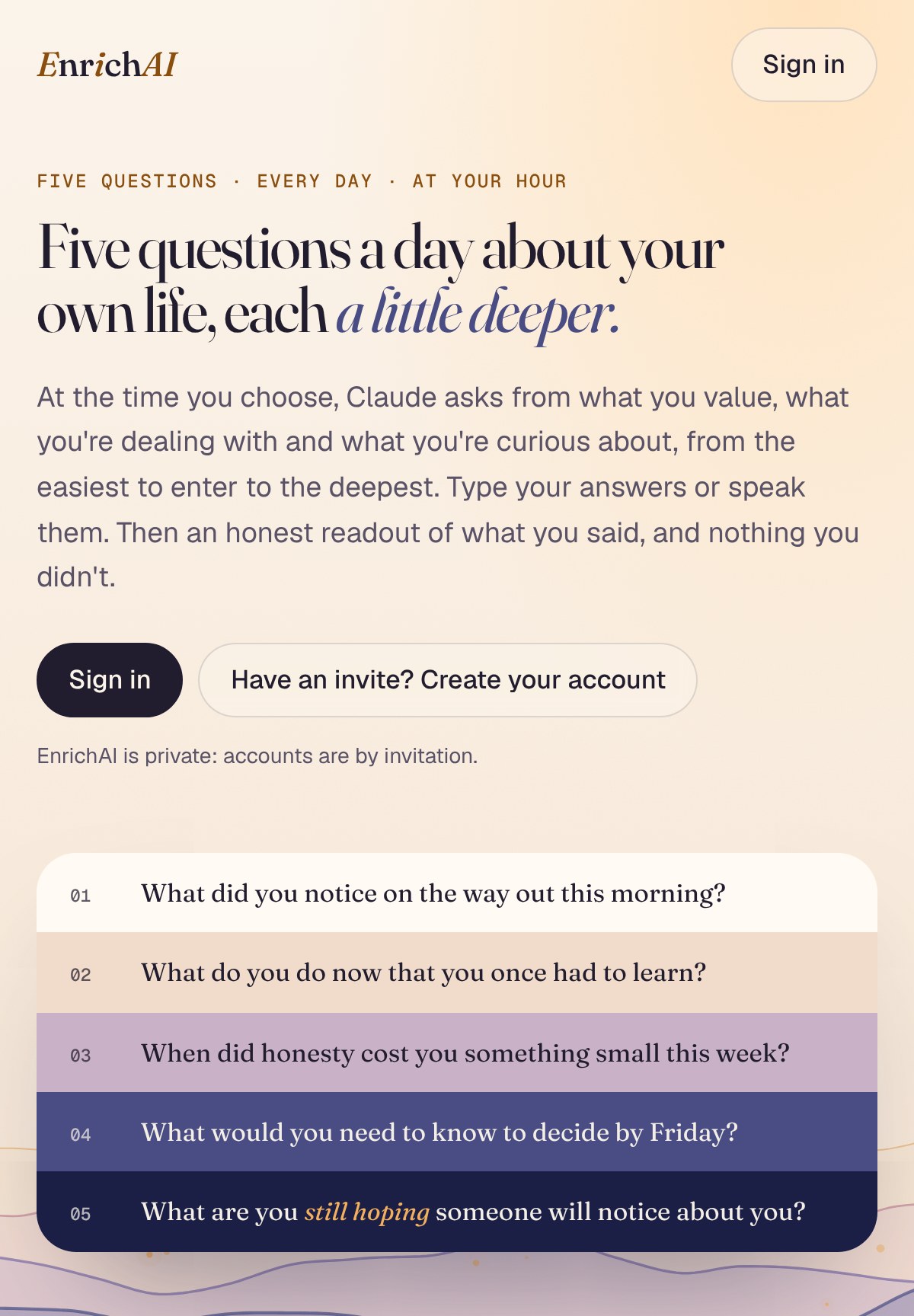
Five questions a day about your own life, at the hour you choose, then a plain readout of what you said, set beside your week and month.
To journal about a good day, write down what happened in the order it happened, with the details you noticed, and leave out the reasons it went well. In experiments, students who analyzed their happiest day in writing reported lower well-being four weeks later than students who replayed it, and the likely cause is that making sense of a good event shortens the pleasure it gives.
That is the opposite of what helps after a hard day, where working out the reasons on paper does some good. EnrichAI asks five questions a day about your own life, and none of them can be answered yes or no. One question on its home page reads "What did you notice on the way out this morning?" A question of that kind asks for the day itself and not for a theory of it.
Where the habit of writing down good things comes from
The modern form of the habit comes from two experiments. In February 2003, Emmons and McCullough at the University of California, Davis assigned people at random to one of three conditions: listing hassles, listing things they were grateful for, or a comparison condition. People then kept records of their moods and health, weekly in one study and daily in another. The groups that listed things to be grateful for came out ahead on several measures of well-being, though not on all of them. The steadiest gain was in positive feeling.
In the summer of 2005, Seligman, Steen, Park and Peterson reported an Internet study with six groups assigned at random. Five groups did an exercise meant to raise happiness and one did a control exercise. Three of the five exercises raised happiness and lowered depressive symptoms in a lasting way.
Those two papers made the good-day entry popular. Neither one says what the entry should contain beyond a list.
The experiment that separated replaying from analyzing
In April 2006, Lyubomirsky, Sousa and Dickerhoof at the University of California, Riverside published three studies in the Journal of Personality and Social Psychology. The design was simple.
- Students took measures of well-being and health.
- For 15 minutes on each of 3 days in a row, they wrote about an experience, talked about it into a tape recorder, or thought about it in private.
- Four weeks later they took the same measures again.
In the first study, 96 students worked on their worst experience. Those who wrote or talked reported better life satisfaction and better mental and physical health than those who only thought. In the second study, 111 students worked on their happiest experience, and for life satisfaction the result ran the other way. Thinking in private beat writing and talking.
The third study, with 112 students, asked why. Each one either wrote or thought about a happiest day. Half were told to analyze it step by step. The other half were told to replay it over and over. Students who wrote about their happiest moments, most of all those who analyzed them, reported lower well-being and worse physical health than those who replayed them.
So writing did some of the damage and analysis did more. A sentence on paper tends to grow a "because".
Why explaining a good day shortens it
A paper from January 2005 gives the mechanism. Wilson, Centerbar, Kermer and Gilbert gave people a small good event in three settings. In one, people got an unexpected gift: a dollar coin attached to an index card. For some people the text on the card was easy to make sense of. For others it was hard.
The good mood lasted longer when the event was hard to explain. The authors call this the pleasure paradox, and it runs in four steps.
- A good event arrives that you did not fully expect.
- Your mind starts work on making sense of it.
- The work succeeds, and the event now has a cause.
- The pleasure drops, because the same thinking that explains the event reduces what you get from it.
The same paper reports a second result that matters for anyone holding a pen. People asked to predict their own reaction overwhelmingly chose the version they could explain, and tended to say it would leave them in the better mood. The urge to write down why the day went well is strong, and it points the wrong way.
The one kind of thinking that keeps the day vivid
There is an exception, and it fits the mechanism. In November 2008, Koo, Algoe, Wilson and Gilbert asked college students to write about a good event in one of two ways. One group wrote about how the event might never have happened and why it was surprising. The other wrote about how it became part of their life and why it was not surprising.
The first group reported feeling better. In a further study, people who wrote about how they might never have met their romantic partner were more satisfied with the relationship than people who wrote about how they did meet. Again, forecasters did not see it coming.
Explaining a good event makes it look expected. Writing about how easily it could have gone otherwise brings the surprise back.
A worked example: one Thursday, written two ways
Take a Thursday with three good things in it. A presentation at 10:00 goes well. Lunch with an old friend runs from 12:30 to 2:30. The walk home is dry for the first time in a week.
Entry A explains. The presentation went well because of two weeks of preparation. Lunch ran long because the friendship is an easy one. With that much groundwork, it was bound to be a good day. Each sentence ends in a reason, and the last one says the day could not have gone any other way.
Entry B replays. The first slide stuck and the room laughed. Dana asked about the March numbers and the answer came out clean. At lunch the plates were cleared at 2:30 and nobody had looked at a phone. On the walk home the pavement was pale and dry and the coat stayed open. Then it adds one line of the other kind: the lunch nearly did not happen, because the friend's train was the last one before the line closed.
Entry A matches the analyzing half of the 2006 study and Entry B matches the replaying half. Follow each one forward a month. Entry A leaves three causes on the page and none of the day, so there is nothing to replay. Entry B leaves the stuck slide, a name, two clock times and a dry pavement, which is enough to run the day again. The one line about the train does what the 2008 study describes: it marks the lunch as something that could have been missed.
Had Thursday been a bad day, the choice would flip. Among the 96 students who worked on their worst experience, those who wrote or talked did better than those who only thought.
The strongest objection: small effects and narrow samples
The case for writing down good things at all is weaker than its popularity suggests. In January 2016, Davis and ten colleagues pooled the experiments on gratitude exercises, after a 2010 survey of the studies had cast doubt on them. Against people who only filled in the measures, the exercises raised psychological well-being by a modest amount (d = .31, from 5 comparisons). Against people given some other activity, the gain shrank (d = .17, from 20 comparisons). Against an activity that was itself psychologically active, there was no advantage (d = -.03, from 9 comparisons).
The replay finding has limits of its own. It comes from students. In the same study, writing itself came out behind thinking, so a written replay is the written form the evidence treats best, not one shown to beat replaying a day in your head. The study concerns the happiest day of a life, which is not an ordinary good Thursday. And a dollar coin on an index card is a long way from a good day.
One more result does not sit easily with the rest. In August 2004, Gable, Reis, Impett and Asher at the University of California, Los Angeles reported that telling another person about a good event went with more positive feeling that day, over and above the event itself, and more again when the listener answered with active interest. Yet in the 2006 study, talking about a happiest experience into a tape recorder did worse than thinking on life satisfaction. A tape recorder does not answer. Whether a private entry behaves as the recorder did or as the listener did has not been settled by any of these papers.
Frequently asked questions
Should a journal entry say why a good day went well?
The evidence says to leave it out. In the 2006 study, students who analyzed their happiest day reported lower well-being four weeks later than students who replayed it.
Is a gratitude list the same as an entry about a good day?
No. A list names good things, as in the 2003 experiments. A replay tells one day in order, with its details. The studies that compared replaying with analyzing were about the second kind.
How long should an entry about a good day be?
The first two 2006 experiments used 15 minutes on each of 3 days. None of the studies here compared shorter and longer entries, so the length is an open question.
What a journal about a good day is for
A bad day gains from being worked out on paper, and a good day loses. That asymmetry is the part people get wrong, because the method that helps with trouble seems as if it should help with everything. An entry that serves a good day holds the order of events, the details that surprised you, and at most one line on how it might not have happened. The reasons can stay unwritten. What remains open is how far results from students recalling their happiest day carry over to ordinary good days, and what changes when the entry is spoken to someone who answers.
EnrichAI
Five questions a day about your own life, each a little deeper. Visit enrich.vlvd.net