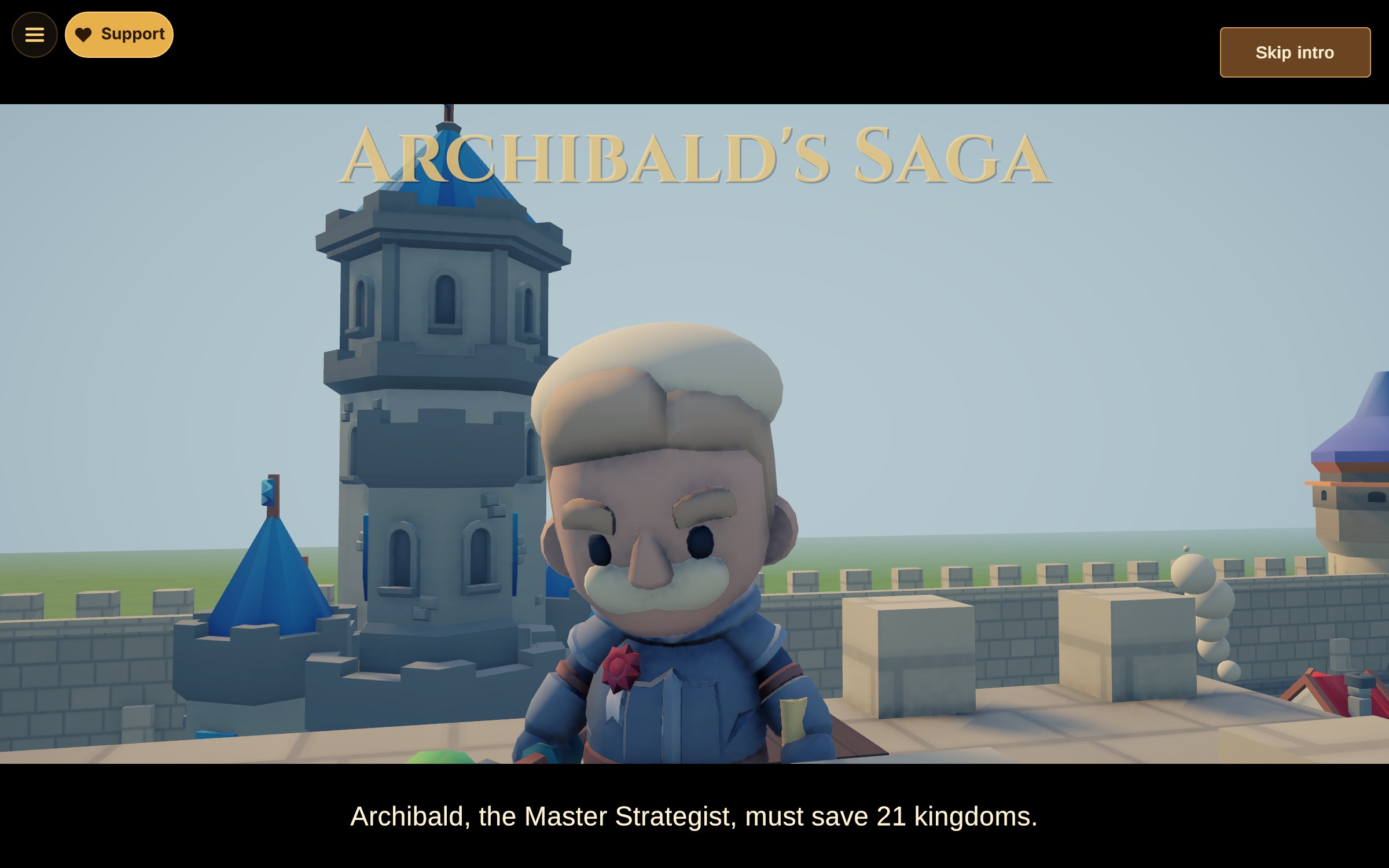
Archibald's Saga
Undermining a Castle Wall: How Siege Mining Worked
Undermining a castle wall meant digging a tunnel under it, propping the roof with timber and burning the props so the wall fell. Two sieges show its limits.
Archibald's Saga
A tower defense strategy game in the browser: play Archibald, the Master Strategist, build towers, command knights and the royal family, and save 21 kingdoms from the Evil Kingdom.
Undermining a castle wall meant digging a tunnel under it, holding the tunnel roof up with timber props, and then burning the props so that the masonry overhead fell under its own weight. Attackers used it against stone walls that could not be burned, and only where the ground could be dug.
Archibald's Saga, a tower defense strategy game played in a web browser, gives the player that defender's job: build towers and command knights and the royal family to hold the gate. Two sieges a year apart show what a mine could do to a tower and a gate, and what it could not.
Undermining a castle wall, step by step
The encyclopedia entry on tunnel warfare describes the medieval mine as a tunnel dug to bring down castles and other fortifications. The work ran in a fixed order.
- Choose ground that can be dug. The method was used when a fortification did not stand on solid rock.
- Dig toward the wall and under it. The tunnel ran beneath the outer defences to the stretch of wall or the tower chosen as the target.
- Prop the roof as the digging goes. Temporary wooden props carried the weight of the earth and stone overhead, so the wall stood on timber where it had stood on soil.
- Pack the space with fuel. When the excavation was complete, it was filled with material that would burn.
- Light it and leave. The fire burned the props away. With nothing under it, the structure was liable to collapse.
The wall was never pushed over. The miners took away its footing, put wood in its place, and then took the wood away all at once.
A related method is sapping. It meant digging at the base of the wall itself with crowbars and picks. At Carcassonne, during the Albigensian Crusade, the chronicler Peter of les Vaux-de-Cernay records engineers bringing a four-wheeled wagon covered in oxhides up to a wall already weakened by stone throwers, and working from under it. Defenders dropped whatever they had on sappers at the foot of a wall.
Rochester, 1215: a corner of the keep brought down
English Heritage's history of Rochester Castle records what it calls the famous siege of 1215. The great keep was built after 1127, when Henry I handed the castle to William de Corbeil, Archbishop of Canterbury, on condition that he fortify it. Between October and December 1215, King John besieged it to take it back from rebels.
The page gives the order of events:
- The royal army broke Rochester Bridge and captured the bailey, the outer enclosure.
- Siege engines threw stones at the rebels inside the keep.
- Miners attacked one point, the keep's south-east turret.
- The props under the undermined masonry were fired with the fat from "40 pigs too fat to eat", in the words English Heritage quotes.
- The south-east corner of the keep came down.
The consequence is the surprising part. The keep did not fall with its corner. The rebels retreated to the northern half of the interior and held on, and the page says it was starvation that soon forced their surrender. The mine had opened the keep, and the siege still ended on food.
The damage is still visible. The turret destroyed in 1215 was square. The south-east turret that stands there now is semicircular.
Dover, 1216: a breach that did not win
A year later the same war reached Dover. English Heritage's account of the sieges of Dover follows an unnamed eyewitness known to scholars as the Anonymous of Béthune. Prince Louis of France attacked from the north, toward the main gate, which was guarded by a barbican, a fortified enclosure outside the gate.
The mine was used twice. First the attackers bombarded the barbican with siege engines, undermined its rampart and captured it. Then Louis set his engines and miners to work on the main gate, and the gate's eastern tower came down. Its collapse left a steep ramp of rubble, and the assault force climbed it into the outer bailey.
The breach did not decide it. The garrison under Hubert de Burgh killed the attackers or drove them back out through the breach, and his engineers closed the gap with a barricade of wooden beams, rubble and earth. Louis began a second siege on 12 May 1217, with engines that included a trebuchet, the first recorded in England, and the garrison held again.
Where siege mining comes from
The method is ancient. The same encyclopedia entry quotes the Greek historian Polybius on the Roman siege of Ambracia. The Romans hid their shaft behind a covered walk about two hundred feet long, built parallel to the city wall, and dug day and night in relays. What gave them away was the spoil: the heap of dug earth grew too high to hide.
The entry also records well-preserved remains of mining and counter-mining at the fortress of Dura-Europos, which fell in 256 or 257 AD.
In the Middle Ages the mine gained a new purpose. Earlier wooden forts could be burned. Stone castles could not, and the mine was developed as the answer: if the wall will not burn, burn what holds it up.
How defenders answered a mine
The first defence was the site. Walls on solid rock, or on sandy or water-logged land, were hard to mine. Builders also put water and depth in the way: the entry names the very deep ditch at Pembroke Castle and the artificial lakes at Kenilworth Castle. A ditch also made a breach beyond it hard to exploit.
The second defence was to dig back. At Ambracia the defenders cut a trench inside their wall, set a row of very thin bronze vessels along it, and listened as they walked past for the sound of digging. Where a vessel sounded, they tunnelled out to meet the Roman mine, and then filled it with smoke from burning feathers and charcoal. Medieval defenders dug counter mines for the same reasons: to break into the tunnel, kill the miners or set fire to the props themselves.
The third defence was a second line. Concentric castles such as Beaumaris were laid out so that an attacker who breached the lower outer wall stood in a killing field, overlooked by a higher inner wall that was still whole.
The strongest objection: a breach is not a victory
The encyclopedia entry says successful sapping usually ended the battle. The two cases here say otherwise. At Rochester the mine succeeded completely, and the defenders gave up later, to hunger. At Dover the mine succeeded twice, and the castle never fell at all.
A mine could only make a hole. Someone still had to go through it, up a steep ramp of rubble, against the garrison. At Dover the defenders won that fight and then closed the wall with timber and earth. A mine also needed ground that could be dug, and the spoil could betray it, as at Ambracia.
The common mistake runs the other way: picturing an explosion. Nothing exploded at Rochester or Dover. The weapon was fire and the wall's own weight. Gunpowder entered mining in the 15th century in Italy, where it cut the effort needed to bring a wall down.
What the accounts do not settle
The sources cited here leave plain questions open. None gives the length or depth of the Rochester mine, the number of miners, or how many of the siege's weeks the digging took. The siege lasted from October to December, and the mine was only one part of it.
The evidence is thin in another way. The sequence at Dover rests on a single eyewitness whose name is not known, and English Heritage says only that this account lets scholars understand the basic sequence. Rochester is known from chroniclers whose descriptions the same body calls vivid.
It is also unclear how much credit the mine deserves at Rochester. The bombardment, the loss of the bailey and hunger pressed on the same garrison in the same weeks.
Frequently asked questions
Did medieval miners use gunpowder to bring down castle walls?
Not in the sieges described here. In 1215 and 1216 the miners burned timber props, and at Rochester the fuel was pig fat. Gunpowder changed mining in the 15th century.
What is the difference between mining and sapping?
Mining is a tunnel dug under the wall from a distance. Sapping is digging into the foot of the wall itself with crowbars and picks.
How did a castle stop a mine?
By standing on rock or wet ground, by a deep ditch or wide water, and by counter mines dug from inside to reach the attackers' tunnel. An inner wall behind the outer one limited what a breach was worth.
Why was pig fat burned at Rochester Castle?
It fired the timber props that held up the undermined south-east turret of the keep. When the props burned through, the corner of the keep fell.
What undermining a castle wall changed in castle building
Both castles were rebuilt around the lesson. Rochester's lost square turret came back semicircular. At Dover, English Heritage's history of the castle records that once the war ended in 1217 the vulnerable north gate was blocked solid. Two new gates replaced it, Constable's Gate on the west side and Fitzwilliam Gate on the east, and the builders cut a tunnel of their own under the outer wall so the garrison could reach the remade barbican.
The mine left its mark on stone that was never mined. Deep ditches, wide water, walls inside walls and gates moved away from the easy approach all answer the same threat: miners with picks, a stack of timber and enough fat to start a fire.
Archibald's Saga
Build your towers, hold the gate, and save 21 kingdoms. Visit archibald.vlvd.net